Definition and categories
The term “energy” covers many and diverse realities. If we put aside its imaginary uses as “a man full of energy”, energy designates an ability to act in whatever mode: set in motion, heat, compress, light, sound, transmit a information, etc.
In common parlance, the term “energy” is used in place of “energy usable by humans”, also called “free energy”. So when reference is made to energy consumption, we must understand consumption of energy usable by humans or consumption of free energy. This precision is all the more important since the scientific world has demonstrated that in an isolated system (as our universe can be) the total energy is always conserved (first principle of thermodynamics), which excludes any consumption or energy loss. Conversely, the energy usable by humans, which constitutes a sub-part of the total energy, can actually be consumed.
The history of man has been substantially marked by the evolution of the sources of free energy which he knew or could use. Until about 500,000 years ago, the only free energy available to man was his own energy. By controlling fire to heat, cook, light or work metals, he took the first step in his energy learning. Then came the use of domestic animal energy, wind, hydraulic, thermal cycles, chemical, electrical, nuclear, solar, etc. Each of these stages was the occasion of an evolution most often major of the structures of human societies.
Free energy forms
Today the energy usable by man comes in multiple forms. Notwithstanding this diversity, scientists have succeeded in establishing equivalences so that they can use the same units of measurement for each of them. In the following list, reference will be made to forms which may, under certain conditions, be transposed into others. For example, nuclear energy can be transformed into electrical energy . In these transformations, there is overall a degradation of the energy passing from a more or less noble and structured stage ( chemical energy, radiation energy, etc.) towards a final stage of heat, that is to say of disordered movement of molecules. These partially irreversible transformations obey among others the second principle of thermodynamics.
Gravitational energy
It arises from the direct and reciprocal attraction between two massive bodies. It is negligible for small objects between them but becomes major on a larger scale. It is it which sets in motion towards the ground an object made free or which generates the movement of the planets around the sun. It is used for example in hydraulic dams where, by causing water to flow in pipes, it makes it possible to set turbines in motion.
Kinetic energy including wind energy
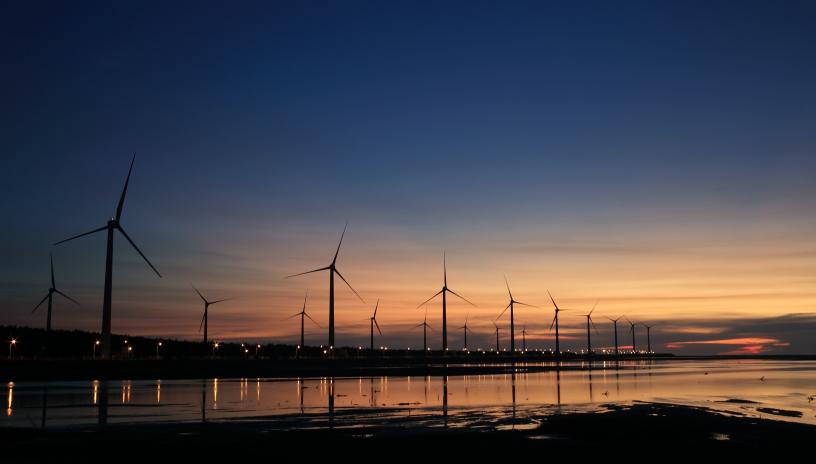
It is born from the movement of a massive body. It is this which characterizes the energy of a car launched on the road or that of the wind. It is omnipresent in its microscopic effects because it is the kinetic energies of the molecules and atoms of a body which determine its temperature level. The temperature is thus an indirect measure of the degree of agitation of the particles. Kinetic energy makes it possible to set in motion the blades of wind turbines which themselves activate electricity generators.
Thermal or caloric energy
It arises from the temperature of a body which, depending on the case, can diffuse heat for cooking, to accelerate chemical reactions but also to generate movements. This generation of movement is only possible if the temperature of a body can be compared with the temperature of a colder body. This physical law was clarified in the second principle of thermodynamics. Thermal energy had an essential role in the industrial revolution, notably allowing the production of steel and the setting in motion of steam locomotives. Today it operates turbines and alternators generating electricity.
Geothermal energy , heat from the earth, is a special case of thermal energy.
Radiative energy including solar energy
It arises from received radiation. These are, depending on their wavelength, of different natures (radio waves, visible light, Ultra-violet rays, X-rays, etc.) but have in common the ability to move even in a vacuum and this at the speed light. It is the radiative energy that allows a light bulb to light, a microwave oven to cook food, a radar to measure a speed. The Sun is an important source of radiation received on Earth. It sends us a significant level of energy in small packets called photons, with different wavelengths. It is this energy that is recovered directly into electricity in photovoltaic power plants , or in heat subsequently transformed into electricity inthermodynamic power plants .
Chemical energy including fossil fuels
It arises from bonding forces grouping atoms in a molecule. In chemical reactions where new molecules are frequently reconstituted, which are more chemically stable than the initial molecules, an amount of heat is released. It is it which is used in an accumulator or an electric cell by releasing energy recovered in movement of electrons, that is to say in electricity. It is it which is released in the combustion of a log, for example in a fireplace. Fossil fuels ( oil , gas , coal ) are a special form of chemical energy. Energy from biomass is also of chemical origin.
Electrical energy
It arises from the movement of electrons in a conductor. Its production comes from the consumption of other forms of energy. It is she who drives the electric motors, operates the integrated electronic circuits and the different types of lighting. It is characterized by a great ease of distribution but presents a storage difficulty. Its field of application continues to grow.
Nuclear energy
It arises from the use of the bonding forces of protons and neutrons within the nucleus of atoms. By transforming by heavy atoms such as uranium 235 or by fusion of light atoms such as hydrogen isotopes, a nuclear reaction releases heat, neutrons, alpha, beta, gamma rays … The heat of fission is used in nuclear power plants to activate electricity generators through heat transfer fluids. The heat of fusion is experimentally used widely in the tokamak of ITER for any industrial operation at the end of the XXI th century / beginning of the XXII e .
Classification
Depending on the points of view and / or needs, the forms of energy are classified and quantified.
Primary energy consumption
In order to record energy consumption without omission or double counting, the concept of primary energy consumption was created. This takes into account the energy consumption directly in the service of men (like gas when it is used for central heating) and the energy consumption indirectly in the service of men also called intermediate consumption which take part in processes aimed at producing goods and services useful to humans (such as gas when used in a chemical reaction). Conversely, energy consumption in order to produce another form of free energy (such as the gas used to generate electricity) is not counted in primary consumption.
Renewable or non-renewable energies
As regards sustainable development considerations, energy sources are frequently classified into two categories: renewable and non-renewable. The term renewable is not to be taken literally, it should be said “renewable on a human scale” since the sun which is the direct or indirect essential motor has a limited lifespan. The first includes solar energy (radiative energy), wind energy (kinetic energy), biomass (chemical energy), hydraulic energy (kinetic energy). In the second, fossil fuels (chemical energies) and nuclear are listed. Strictly speaking, fossil and nuclear energy could also be considered renewable but over periods too long to be taken into account on a human scale.
CO 2 emission
When it comes to dealing with the problem of greenhouse gases , energy sources are classified into two categories. In the first, those that do not generate CO 2 in their use. It includes wind, solar, hydro and nuclear energy. In the second, the others. However, this differentiation deserves to be analyzed with more finesse. Certain generations of photovoltaic panels can emit by their manufacture, their routing and their installation, a quantity of CO 2 of the same order of magnitude as what they save in their later use.
Units of measure and key figures
The international system has chosen as a unit for energy, the joule named after a British physicist of the XIX th , James Prescott Joule. The joule is consistent with the more commonly used units of kilograms, meters and seconds. However, this unit is too important for practical reasons when it is a question of studying the movement of an electron for example or too weak when it is a question of measuring the energy consumption of a hearth and a fortiori the energy production of a section of nuclear power plant. This is how many other units are used, from the electron volts per kilowatt hour to the terawatt hour, or even the tons of oil equivalent.
Future
The history of man has been substantially marked by the free energies to which he could have access. Today, energy is a systematic and essential factor in human activities. The future will probably be part of the same problem. The increase in the population of the planet, the increase in the standard of living of the inhabitants of emerging countries, the finite and therefore limited nature of the reserves of fossil fuels will contribute to increase and tend the needs for free energy. Faced with this, the answers will have to be found in a more efficient use of energy, in an increased use of renewable and nuclear energies.
 Xfinity Tech Blog